 ultimate-guide
Best Way to Teach a Teen Driver: A Parent's Guide
Table of Contents
- Why the Best Way to Teach a Teen Driver Starts With House Rules
- Essential Driving Skills for Beginners: Build Them in Order
- Behind-the-Wheel Sessions: How to Structure Supervised Driving
- Tracking Progress With a Teen Driving Practice Log
- DMV Road Test Preparation Tips for South Carolina Teens
- The Benefits of Professional Driving Schools for Families
- Vehicle-Specific Instruction: Teaching Your Teen in Your Own Car
- Conclusion: The Best Way to Teach a Teen Driver Is a Team Effort
- Frequently Asked Questions
Last Updated: October 1, 2026
Why the Best Way to Teach a Teen Driver Starts With House Rules
The best way to teach teen driver habits is to set clear house rules before the engine ever turns over. A written agreement covering phone use, passenger limits, and night driving gives you a shared standard when nerves run high. At Aiken Driving School, we've watched Aiken County families succeed when expectations are agreed on in the kitchen, not argued about at 60 mph.
Essential Driving Skills for Beginners: Build Them in Order
Essential driving skills for beginners should be taught in sequence, not all at once. Start with vehicle control in low-stakes spaces, then layer in situational awareness, hazard perception, and only then traffic.
The order matters more than the speed:
- Vehicle control - steering technique, acceleration control, braking distance
- Situational awareness - scanning, mirror adjustment, blind spots
- Traffic laws - traffic signals, right-of-way, intersection safety
- Defensive driving - hazard prediction, emergency maneuvers
- Highway merging and night driving last
Start in a Parking Lot: Space to Learn Vehicle Control
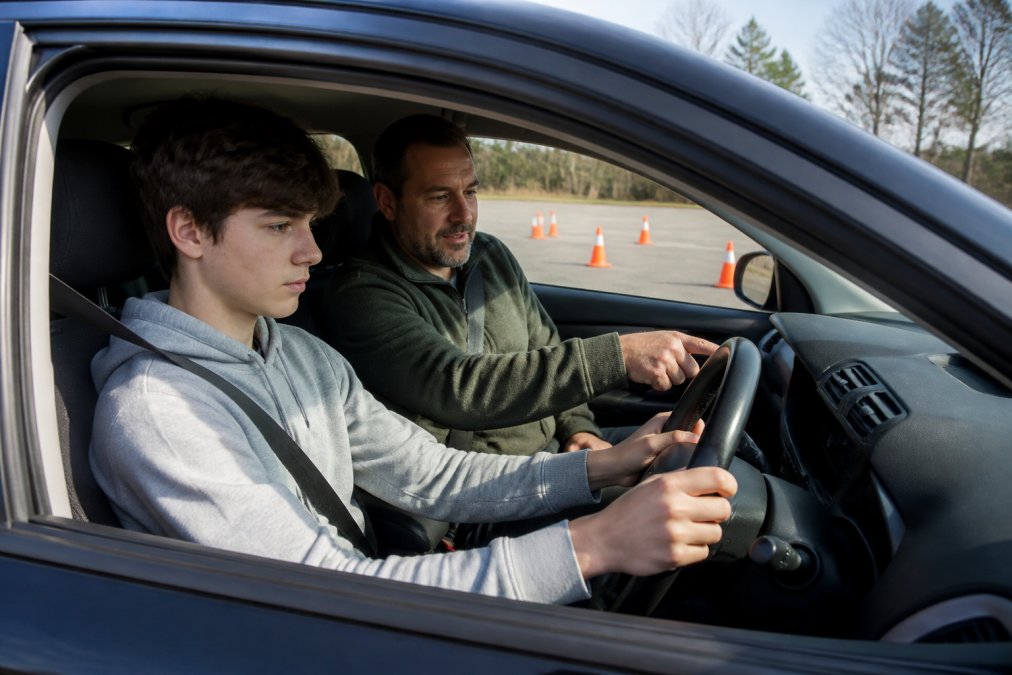
An empty parking lot is the best classroom for the first three sessions: no traffic, and room to make mistakes that cost nothing. Use cones or painted lines to mark a slalom, a parking box, and a mock intersection.
Mirror Adjustment and Seating Position: Set Them Before Every Drive
Mirror adjustment and seating position get set before every drive, no exceptions.
Walk through it out loud each time:
- Seat far enough back that the knee keeps a slight bend when the brake is fully pressed
- Seatback upright enough that the wrist rests on top of the wheel with the shoulder blades still on the seat
- Side mirrors angled so the side of the car is barely visible
- Rearview mirror framed to show the full rear window
- Headrest level with the top of the ear
Behind-the-Wheel Sessions: How to Structure Supervised Driving
Behind-the-wheel sessions work best at 45 to 60 minutes, three to four times a week. Shorter, frequent drives beat one long weekend session, so rotate routes instead of memorizing one path.
A simple structure that holds up:
- 5 min: pre-drive check (mirrors, seat, seat belt safety, fuel)
- 10 min: warm-up on quiet residential streets
- 20-30 min: the day's focus skill (intersections, merging, night driving)
- 10 min: cool-down and a two-minute debrief in the driveway
Managing Parent-Teen Emotions in the Passenger Seat
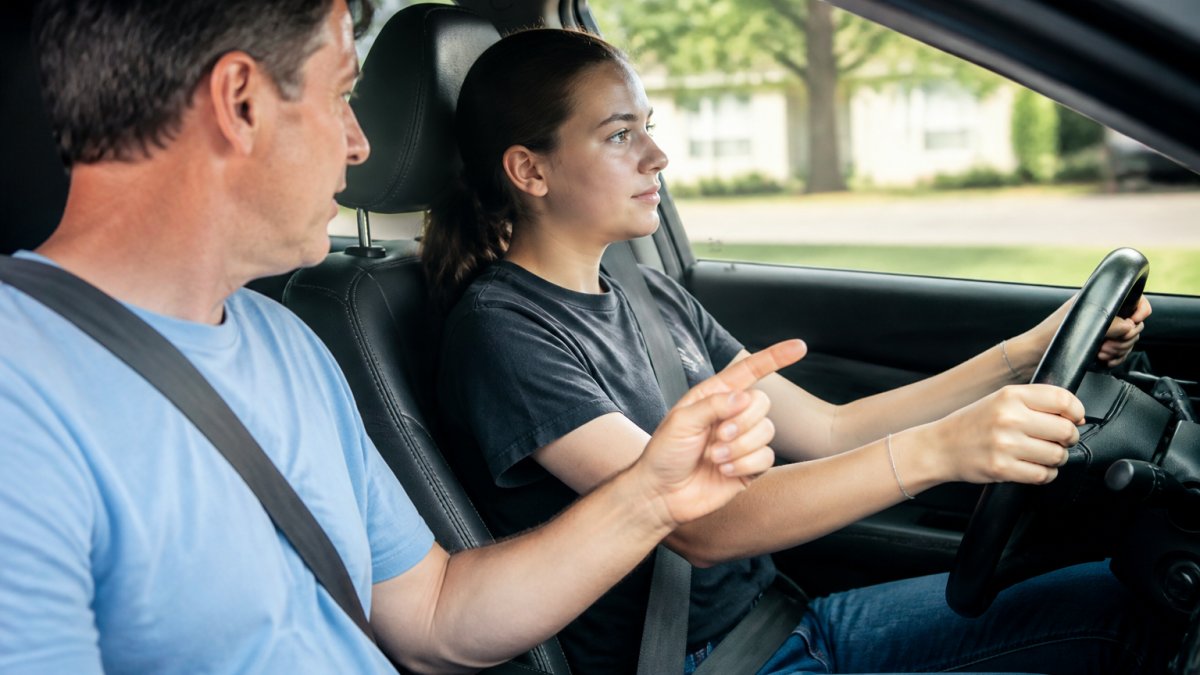
Your job in the passenger seat is to stay boring: calm voice, short instructions, no gasping. Grab the door handle or hit the imaginary brake and your teen's situational awareness collapses, they start driving to please you instead of driving the car.
Try these habits:
- Give directions three to five seconds ahead, not at the last second
- Use neutral language: "Ease off the gas" beats "Slow down!"
- Save corrections for after the drive when the car is parked
- If you feel your own stress rising, pull over and swap drivers
Modeling Safe Driving Behavior on Every Trip
Modeling behavior is the quiet part of how you teach teen driver habits, and most parents underestimate it. Your teen has watched you drive for 15 years and absorbed your habits, good and bad. Roll through stop signs or text at red lights, and they will too.
Tracking Progress With a Teen Driving Practice Log
A teen driving practice log turns vague progress into a number you can both see. Most states, including South Carolina, require documented supervised driving hours before a permit holder can test for a license, so a log is often a legal requirement, not just motivation.
| Log Column | What to Record | Why It Matters |
|---|---|---|
| Date and duration | 45-60 min sessions | Proves hours for the DMV |
| Road type | Parking lot, residential, highway | Shows skill variety |
| Weather and light | Clear, rain, day, night | Night driving must be logged separately |
| Focus skill | Merging, intersections, parking | Tracks weak spots over time |
| One win, one fix | Short note from each drive | Gives the next session a target |
South Carolina DMV teen licensing requirements
DMV Road Test Preparation Tips for South Carolina Teens
DMV road test preparation tips come down to three things: know the route types, practice the maneuvers the examiner scores, and manage test-day nerves.
Build these into the last two weeks of practice:
- Parallel parking, three-point turns, and backing into a space
- Full stops at traffic signals and stop signs, held for a clear three-count
- Lane positioning through turns (stay in your lane, signal early, check mirrors)
- Intersection safety at four-way stops and unprotected left turns
- Smooth, deliberate mirror adjustment and seat belt use before pulling out
How Examiners Actually Score the Drive
Most states use a point-deduction sheet. Knowing the categories changes how you practice:
- Critical errors, the examiner intervenes (grabs the wheel, hits the brake) or the driver violates a law or causes a near-miss. One of these typically ends the test.
- Non-critical errors, missed mirror checks, hesitation, rolling stops, improper lane position. These accumulate, and too many add up to a fail.
- Automatic-fail items commonly include hitting a curb during a maneuver, running a red light or stop sign, failing to yield, speeding in a school or work zone, and any collision.
The First Six Months After the License
The road test is a milestone, not a finish line. The highest-risk window for a newly licensed teen is the first six months of solo driving, so plan for it before the license is in hand:
- Solo-driving anxiety. Some teens are fine with a parent aboard and freeze when alone. Do short, low-stakes solo trips first, a five-minute run to the store on familiar streets, before longer or faster routes.
- Night driving protocol. Start with dusk, then early evening, then full dark on routes the teen already knows in daylight. Log night hours separately, since most graduated licensing rules require them.
- Passenger and hours rules. Many states restrict peer passengers and late-night driving for the first several months. Treat those limits as the floor, not the ceiling.
- A check-in habit. Agree on a text when the teen arrives and when they leave. It's not surveillance, it's a shared safety routine that also builds trust.
South Carolina DMV teen licensing requirements
The Benefits of Professional Driving Schools for Families
The benefits of professional driving schools show up fastest in two areas: correcting bad habits before they harden, and reducing family friction. A neutral instructor can say what a parent can't, and teens hear it differently from someone who isn't Mom or Dad.
Where a school helps most:
- Anxious teens who shut down when a parent corrects them
- Busy families who can't find 50+ hours of consistent practice time
- Test-day nerves, since practicing with the same examiner reduces surprises
- Defensive driving and emergency maneuvers that are hard to safely rehearse at home
Vehicle-Specific Instruction: Teaching Your Teen in Your Own Car
Your teen will test and drive in a specific vehicle, so teach them in that vehicle. Every car has its own blind spots, dashboard layout, and pedal feel, and learning those quirks in advance is one of the most overlooked parts of driver education. Body style and drivetrain change how you teach, not just what you teach.
Spend one full session on the car itself:
- Where the hood ends and how that affects lane positioning
- Where the blind spots sit and how mirror adjustment shrinks them
- How the brakes feel in a controlled stop (find an empty lot and practice)
- Where the hazard lights, defroster, and wipers live
- How the car handles in rain, since braking distance changes fast
Sedan vs. SUV vs. Truck: What Actually Changes
The physics differ enough that a teen who learns in one body style will feel off in another:
- Sedans sit lower, so the driver sees less over the car ahead. Teach following distance by counting seconds, not car lengths, three seconds minimum in dry conditions, four or more in rain.
- SUVs and crossovers have a higher center of gravity, so they lean more in turns and roll further in a panic swerve. Practice slower entry speeds into curves and earlier, smoother braking.
- Pickup trucks have a long hood and a much larger rear blind zone. A backup camera helps, but the tailgate and bed corners still hide objects. Walk the perimeter before every reverse until the habit is automatic.
- Lifted or modified vehicles change the sightlines and braking feel entirely. If your teen will drive one, do the parking-lot calibration session again from scratch.
Teaching an EV: Regenerative Braking and One-Pedal Habits
If your household car is electric, the biggest adjustment isn't acceleration, it's deceleration. Regenerative braking slows the car the moment the driver lifts off the accelerator, so the brake pedal gets used far less. That creates two teaching problems:
- The teen may never build brake-pedal muscle memory. Set the regen to its lowest setting for the first few sessions so they still practice real braking.
- Following distance feels different. Because the car slows itself, teens tend to follow closer than they would in a gas car. Push the three-second rule harder, not softer.
Using ADAS as a Teaching Tool, Not a Crutch
Modern driver assistance features, lane-keep assist, adaptive cruise control, blind-spot monitoring, automatic emergency braking, are the biggest gap in most parent-taught programs. Treat them as a second set of eyes, never the primary one.
A workable framework:
- Name the system and its limit. Lane-keep assist nudges, it doesn't steer. Blind-spot monitoring sees radar, not a fast motorcycle in the next lane. Adaptive cruise control can be fooled by a slow-moving or stopped vehicle ahead.
- Drive one session with the features off (where the vehicle allows it) so your teen learns to scan, judge gaps, and brake without a safety net.
- Then turn them on and narrate. "The light in the mirror means a car is in my blind spot, I still turn my head to confirm."
- Debrief every false alarm. When the system beeps and there's nothing there, that's a teaching moment about sensor limits, not a reason to ignore the warning.
Don't rely on a backup camera alone. Cameras have blind spots too, especially at the corners. Teach your teen to turn their head and check mirrors before reversing, every time.
Conclusion: The Best Way to Teach a Teen Driver Is a Team Effort
Teaching a teen to drive is one of the few parenting jobs where the goal is to work yourself out of a job. House rules, structured practice, a written log, and honest modeling get you most of the way. The rest comes from patient, professional instruction that meets your teen where they are.
Frequently Asked Questions
What is the best way to start teaching a teen to drive?
Begin in an empty parking lot with the engine off, reviewing controls like turn signals, mirrors, and seat belt safety. Once your teen knows where everything is, start the car and practice gentle acceleration, braking, and steering at low speeds. This removes traffic pressure and lets them build vehicle control before they face real roads.
How many hours of supervised driving does a teen need?
South Carolina requires teens to complete at least 40 hours of supervised driving, including 10 hours at night, before getting a full license. Spread those hours across varied conditions: city streets, rural roads, and highways. A teen driving practice log helps you track each session and confirm you have met the state requirement when you visit the SCDMV.
How can I stay calm while teaching my teenager to drive?
Keep your voice neutral and your instructions short. Instead of gasping or grabbing the wheel, say what you want them to do next: 'Ease off the gas' or 'Check your blind spot.' Schedule practice when you are not rushed, and take breaks after 30 minutes. If tension rises, end the session on a positive note and try again another day.
When should a teen start professional behind-the-wheel training?
Many families bring in a professional instructor after the teen has logged 10 to 15 hours of basic practice with a parent. At that point, a certified instructor can teach more advanced skills like highway merging, emergency maneuvers, and night driving. Professional training also helps teens who are anxious or who have developed bad habits at home.
How do I prepare my teen for the DMV road test?
Practice the exact maneuvers the examiner will score: parallel parking, three-point turns, lane changes, and intersection safety. Review the South Carolina driver's manual together and take practice written tests. Schedule a mock road test with a driving school that is an SCDMV-approved third-party tester to help your teen prepare before the real thing.
Do I need a practice log for my teen driver?
Yes. South Carolina requires a certified driving log showing at least 40 hours of supervised driving, with 10 of those hours at night. A teen driving practice log also helps you see which skills need more work, such as highway merging or night driving, so you can target your remaining practice sessions instead of repeating what your teen already knows.
What are the most important driving skills to teach a beginner?
Start with mirror adjustment, seating position, and seat belt safety before the car moves. Then build up through steering technique, acceleration control, braking distance, and lane positioning. Once those are solid, move to intersection safety, hazard perception, highway merging, and emergency maneuvers. Defensive driving habits should be woven into every session.
Should I hire a driving school or teach my teen myself?
Most families do both. Parents handle the early parking lot practice and basic supervised driving hours, while a professional school covers advanced skills, defensive driving, and DMV road test preparation. The benefits of professional driving schools include structured lessons, SCDMV-approved testing, and instructors who can correct habits parents may not notice.